Human Systems Lab
The Operating System
for School Counselling.
Built so you can give every child sitting across from you the attention they deserve: one quiet place to hold it all, so your eyes can stay on them, not on the screen waiting after.
Scroll
What you're carrying
You're holding hundreds of children in your head, with nothing built to help you hold them.
3%
Of Indian schools have an appointed counsellor
The overwhelming majority run with none at all, formal policy notwithstanding.
1 : 500
CBSE's mandated minimum, grades IX–XII
A floor set in policy, and one most schools that do have a counsellor still don't reach.
81%
Of students cite exams and academic pressure as their main source of anxiety
The caseload isn't hypothetical. It's what's already sitting with almost every student.
Sources: ASSOCHAM; CBSE counsellor mandate (notified January 2026); NCERT Manodarpan Cell student survey, 2022 (3.79 lakh students, 36 states and UTs).
You might be carrying the stories of hundreds of students at once. Their histories, their assessments, the quiet flags that matter most, scattered across a shared spreadsheet here, a WhatsApp thread there, a drawer of handwritten notes somewhere else. No wonder it's hard to hold. Three things tend to happen when nothing is holding it for you:
A child can slip out of view
When there's no single place every flag can be seen, the child who needs you most can go quietly unnoticed. Not because you weren't watching. Because no one gave you a way to watch everything at once.
Paperwork eats the hours meant for children
Every hour you spend truly listening gets matched by another hour writing it all up afterward, straining to remember exactly what was said. That's an hour that belonged to the next child, or to you.
You end up starting over, every time
You shouldn't have to rebuild a child's story from scratch every time they walk back in, scrambling under pressure. That effort steals from the very space where trust and real reflection are supposed to grow.
Here's what it costs the children you're trying to help: less of your time actually with them, and a greater chance that something important (a signal, a pattern quietly building over months) goes unnoticed. Not because you weren't paying attention. Because nothing was ever built to pay attention with you.
How we close that gap, together
Four gentle steps. Not thirteen screens to hunt through.
01
A student walks in.
Everything you need to know about them is already there, waiting for you. You don't have to scramble to remember.
02
You stay present with them.
The notes, the themes, the quiet risk signals gather themselves gently in the background, while you keep your attention on the child.
03
The paperwork is already done.
By the time the door closes, the documentation is mostly written, built from what was actually said, not from what you can still remember an hour later.
04
Next time, you're already ahead.
Nothing forgotten. Nothing quietly slipping through. You walk in already knowing.
You can see the whole day, screen by screen, in Workflow below.
The films
Or, if you'd rather watch than read.
Five short films on what Psyche.OS is for and who it's for. Nothing to install, nothing to sign up for. Just press play.
Prefer the whole screen? Open the film on its own page. Space pauses it, and the arrow keys skip.
More from the lab
Design philosophy
Ten small promises we don't break.
Whenever we're unsure what to build next, we come back to these first. They're what we ask of ourselves before we ever ask anything of you.
Productivity
→
Presence
Forms
→
Flow
Databases
→
Memory
Records
→
Context
Reporting
→
Reflection
Noise
→
Calm
Disconnected screens
→
Continuous context
Human judgement alone
→
Amplified by silent intelligence
Static status
→
Motion communicates state
Software as destination
→
Software that disappears
The central design language
The Orb is not decoration.
Think of it as the room's heartbeat: one quiet, living thing that gently tells you how the room is feeling, so nothing else has to shout at you. No spinners, no badges, no flashing warnings. Just a soft, honest sense of what's happening.
In the real product this is a GPU-driven particle system,
OrbField.tsx, one draw call and a
single vertex shader carrying somewhere between 18,000 and
46,000 additive particles. What you see here is a lighter 2D
version of the same idea.
Idle
Slow breathing, gentle drift, waiting without ever demanding attention.
Attentive
A slight contraction, a little more coherence. A student has just walked in.
Deep conversation
Stabilised, calm, almost still. Visual silence, so the room can get out of the way.
Processing
The particles reorganise themselves naturally, doing the job a loading spinner used to do.
Crisis
Denser, with a restrained heartbeat. No flashing, no panic red. It's built to protect psychological safety, not perform urgency.
Complete
A gradual dispersion. Information settles into memory, and the session closes gently instead of just stopping.
One heartbeat, felt everywhere.
The Orb is connected to everything happening underneath it
(setOrb, ripple),
so it always reflects the true state of the room. If a
crisis opens somewhere else in the app, you feel it in the
orb before you ever have to read it on a screen.
And when you need to breathe, it breathes with you.
Between sessions, the same orb can lead you through coherent breathing (5·5), box breathing (4·4·4·4), or 4-7-8 breathing. The same gentle particle field, just paced to help you find your own breath again before the next child walks in.
"Motion communicates state."
Intelligence, without interruption
Silent Intelligence.
We never wanted to sell you "AI." We just wanted to give you back the noticing you don't have time for anymore, the pattern you'd catch on the fortieth re-read, if you ever had time for a fortieth re-read. There's no chatbot here, no prompt box to talk to. It simply notices quietly, in the background, and always shows you exactly why.
Before a session
You don't have to dig. The last three sessions surface gently on their own, right when you need them.
During a session
While you're writing, it quietly notices the themes forming, so you don't have to catch every one yourself.
After a session
The structured note is already mostly written, built only from what you actually said.
Across months
Patterns that build slowly get surfaced gently, always with the evidence right there for you to check.
Across years
Even as grades change, staff move on, or a family switches schools, that child's story stays whole.
Drafted automatically. Filed only when you say so.
- · BIRP notes
- · SOAP notes
- · Case summaries
- · Follow-up reminders
- · Risk observations
- · Intervention suggestions
- · Goal tracking
- · Parent/teacher letters
You are always the one who decides. Nothing here replaces your judgement. It just clears the friction out of the way, so more of your time and energy can go to the child in front of you, not the keyboard.
A real screen, not a mockup
The AI insights panel: it notices gently. It never diagnoses; that's still entirely yours to do.
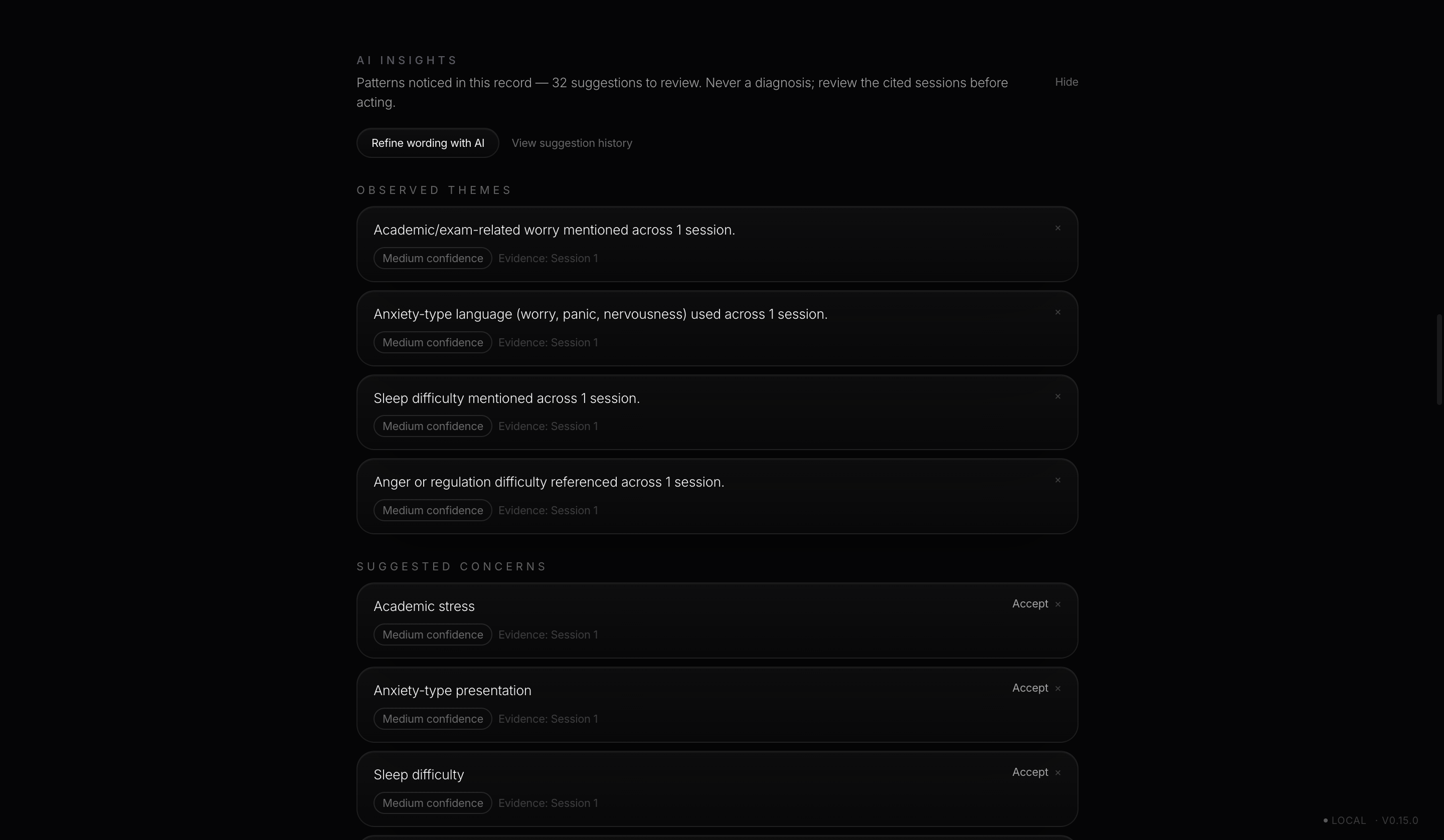
Confidence. Low, medium, or high, honestly worked out from how often and how recently a pattern actually showed up in your own notes.
Evidence. The exact sessions a pattern comes from, so you never have to just take its word for it.
Eight gentle categories in all: observed themes, suggested concerns, goals, interventions, assessments, parent strategies, teacher strategies, and risk indicators. Every single one waits for you to accept or dismiss it. Nothing files itself.
The complete lifecycle
One continuous room, not thirteen disconnected screens.
-
01
A student arrives.
-
02
Their history is already there, waiting.
-
03
The session begins.
-
04
Notes are captured, naturally, as they're spoken.
-
05
Themes start to come into focus.
-
06
Risk patterns are gently surfaced.
-
07
Interventions grounded in evidence are suggested.
-
08
Goals are proposed.
-
09
The documentation writes itself.
-
10
Reports quietly update.
-
11
The timeline grows a little longer.
-
12
A follow-up gets scheduled.
-
13
And long-term knowledge grows, quietly, for next time.
Inside the console
Every screen here is real. This is what waits for you, every day.
Feature 01
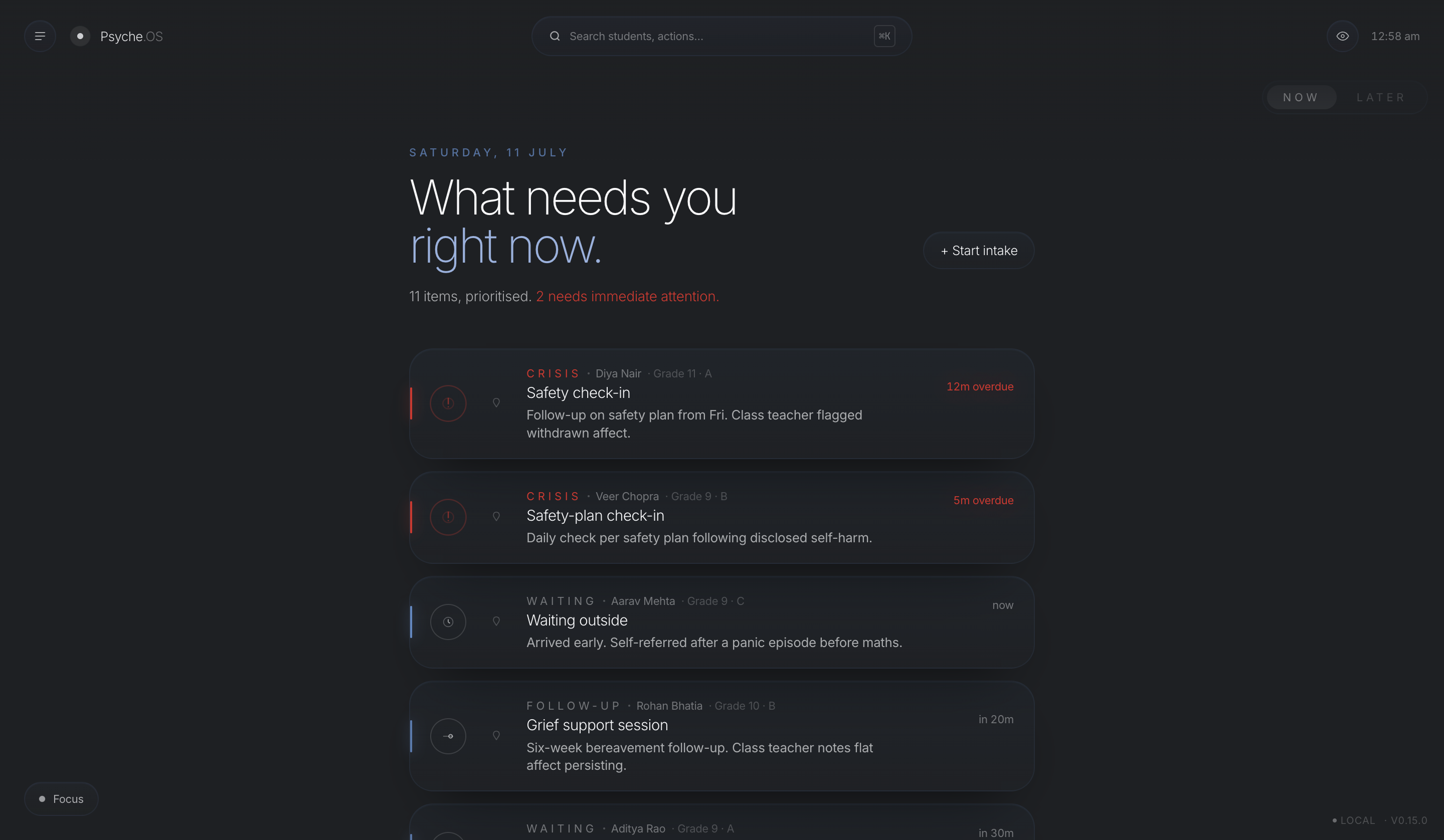
The Now workspace.
What used to happen: your whole day is triage, yet most systems leave you to figure out who needs you most all by yourself, scanning tabs, dates, and flags, piecing it together in your head.
What happens now: one queue that sorts itself, gently. The children who need you urgently rise to the top on their own, and everything else waits patiently until its moment comes.
That whole "who's next" guessing game disappears. You get back the first five minutes of every gap between sessions, minutes that used to just evaporate.
Feature 02
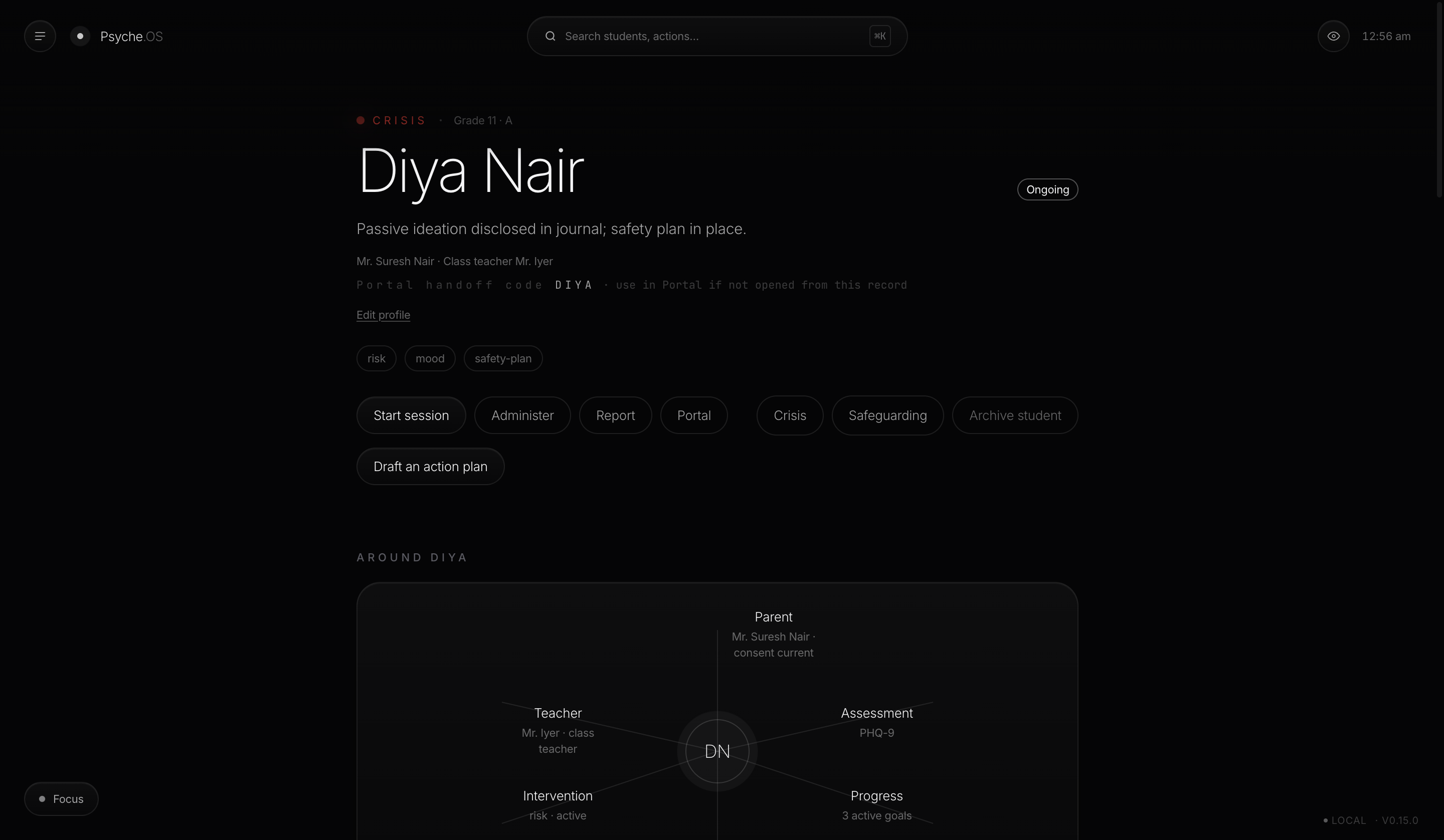
The student record, as a room, not a file.
What used to happen: everything about a child (their parent, teacher, assessments, interventions, their whole progress) lived scattered in five different places you had to piece back together mid-conversation.
What happens now: everything that matters sits gathered around the student, in one view. The living timeline, current concerns, and risk overview are always just a scroll away, never a separate screen to go hunting through.
That reassembly work simply isn't yours to do anymore. Real minutes given back, every single time you open a file, not just once a week.
Feature 03
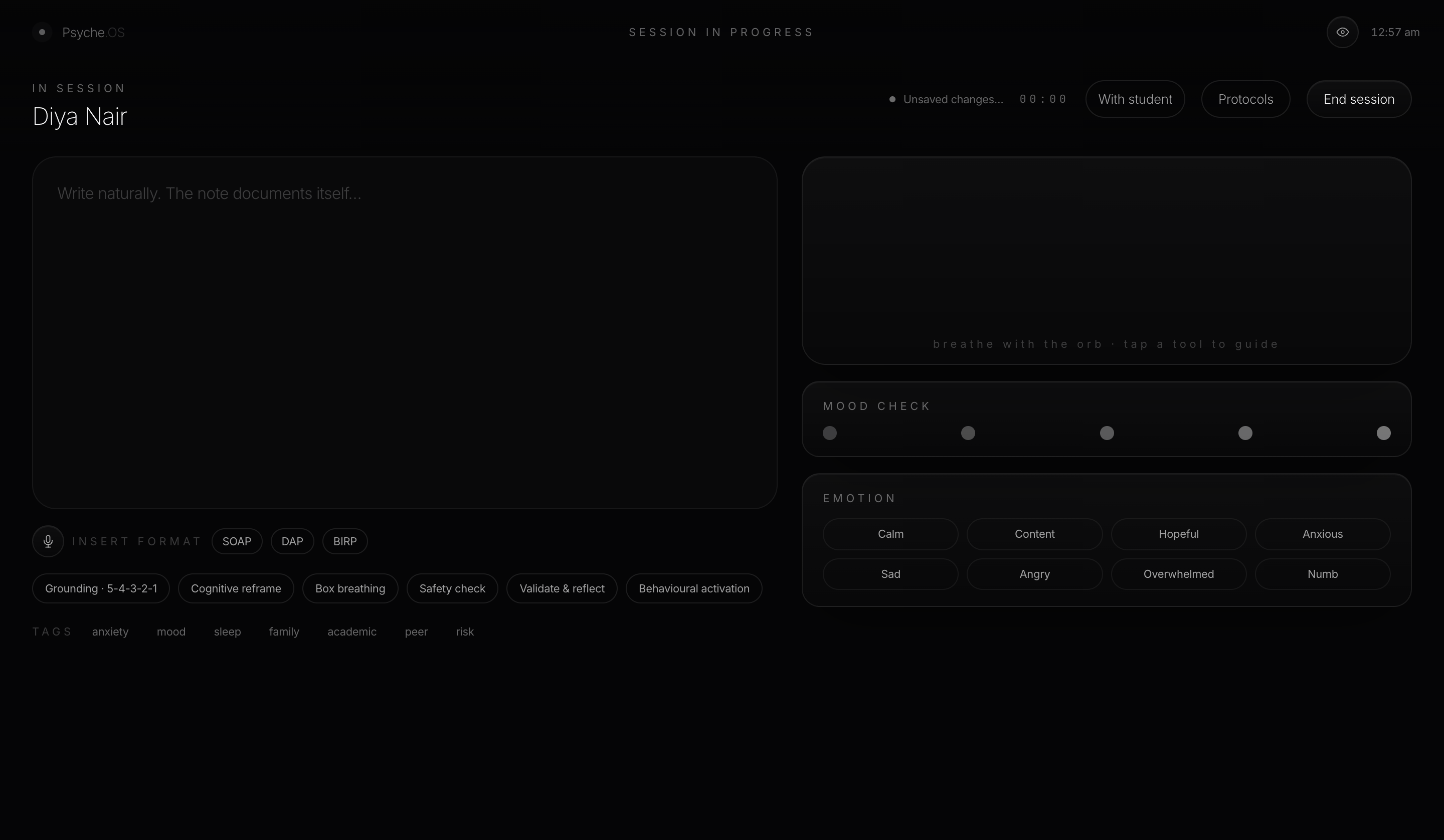
A session mode built to disappear.
What used to happen: typing notes mid-session meant breaking eye contact with a child who needed you looking at them. Put it off, and the small details you meant to remember quietly slip away.
What happens now: one plain, gentle writing surface. Protocol prompts (grounding, box breathing, cognitive reframing) sit a tap away, and SOAP, DAP, or BIRP structure gets applied to whatever you've already written. Never a blank template staring back at you first.
The whole "write it up later" dread just goes away, because the note is already shaped by the time the session ends.
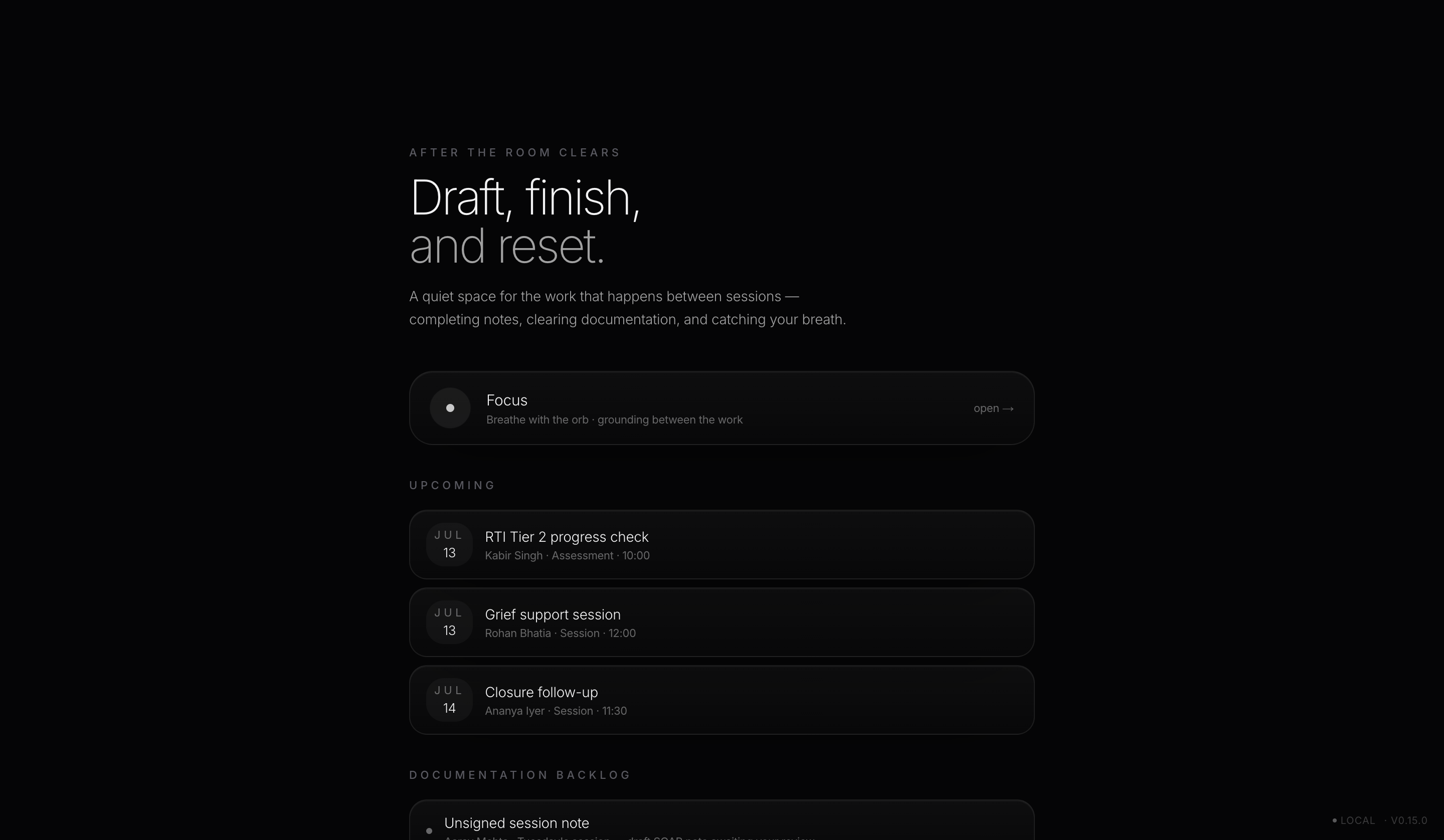
Feature 04
The Later workspace, for after the room clears.
What used to happen: being present with a child and getting the admin done fight for the same hours, and most software never learns to tell them apart.
What happens now: a deliberately calmer second space, just for the backlog, the upcoming appointments, and a guided breathing Focus mode. Paperwork gets its own quiet time, instead of being wedged into the middle of your live queue.
You're spared the constant tug-of-war between "urgent" and "administrative" that a live dashboard would otherwise force on you all day.
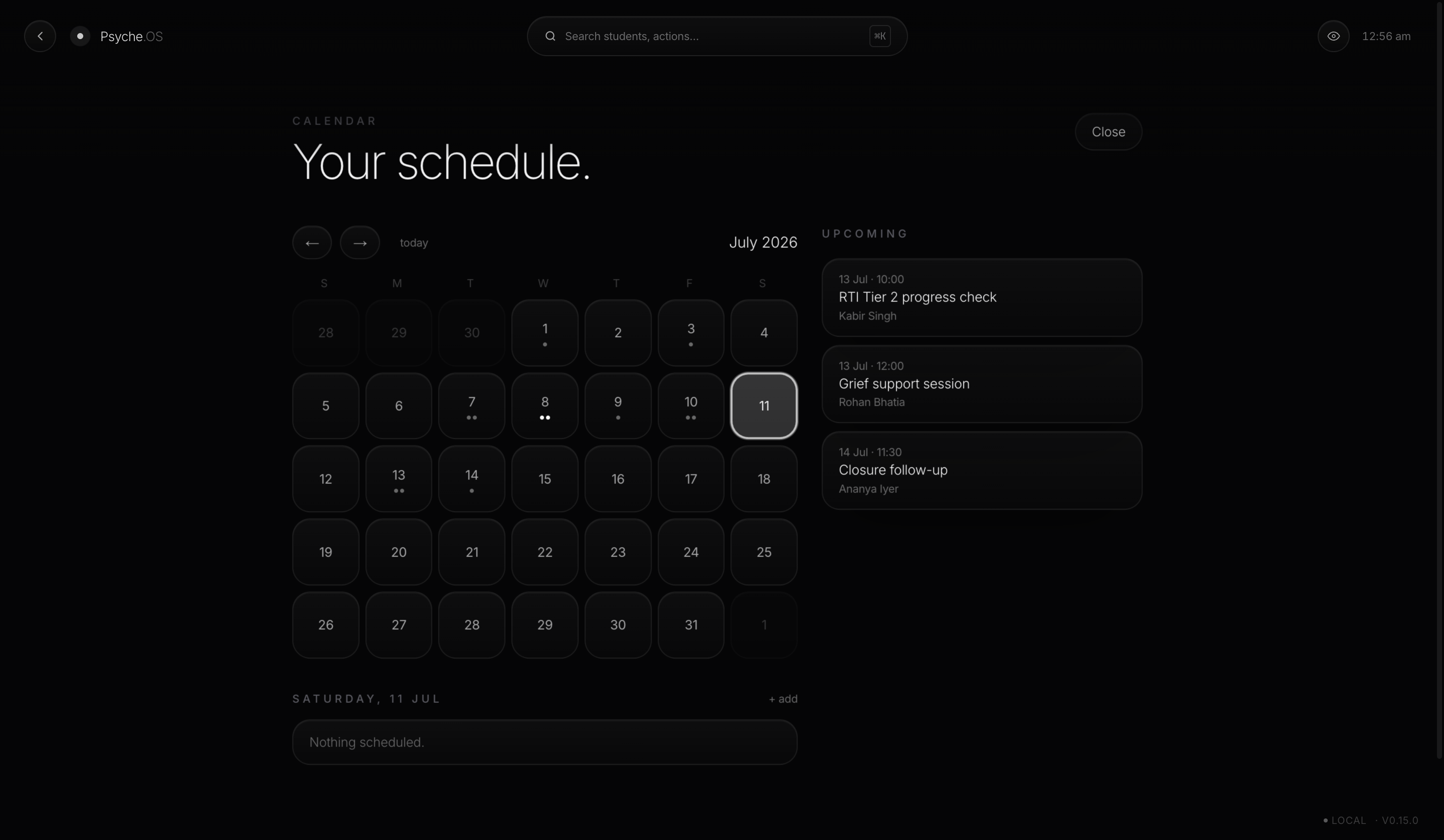
Feature 05
A schedule that already knows the caseload.
What used to happen: your calendar and your caseload lived as two unrelated systems, so booking a session told the schedule nothing at all about the child behind it.
What happens now: every appointment is tied straight to the student it belongs to. Today's session, tomorrow's parent meeting, next week's assessment: all draw from the same continuous story, and feed gently back into it.
No more separate lookup just to remember who your 2:30 actually is.
Feature 06
Five themes, one instrument.
What used to happen: a counselling room gets lived in at 7am and at 7pm, on a shared laptop and a personal one, by people with different eyes and different needs, and most software offers one look and calls it a day.
What happens now: Graphite, Teal, Paper, Olive, and Slate. Five complete, calm surfaces built from the same caring design, each with its own quiet accent, none of them ever shouting at you.
Every theme keeps the same gentle rule: emphasis comes from light, never from noisy colour.
Feature 07
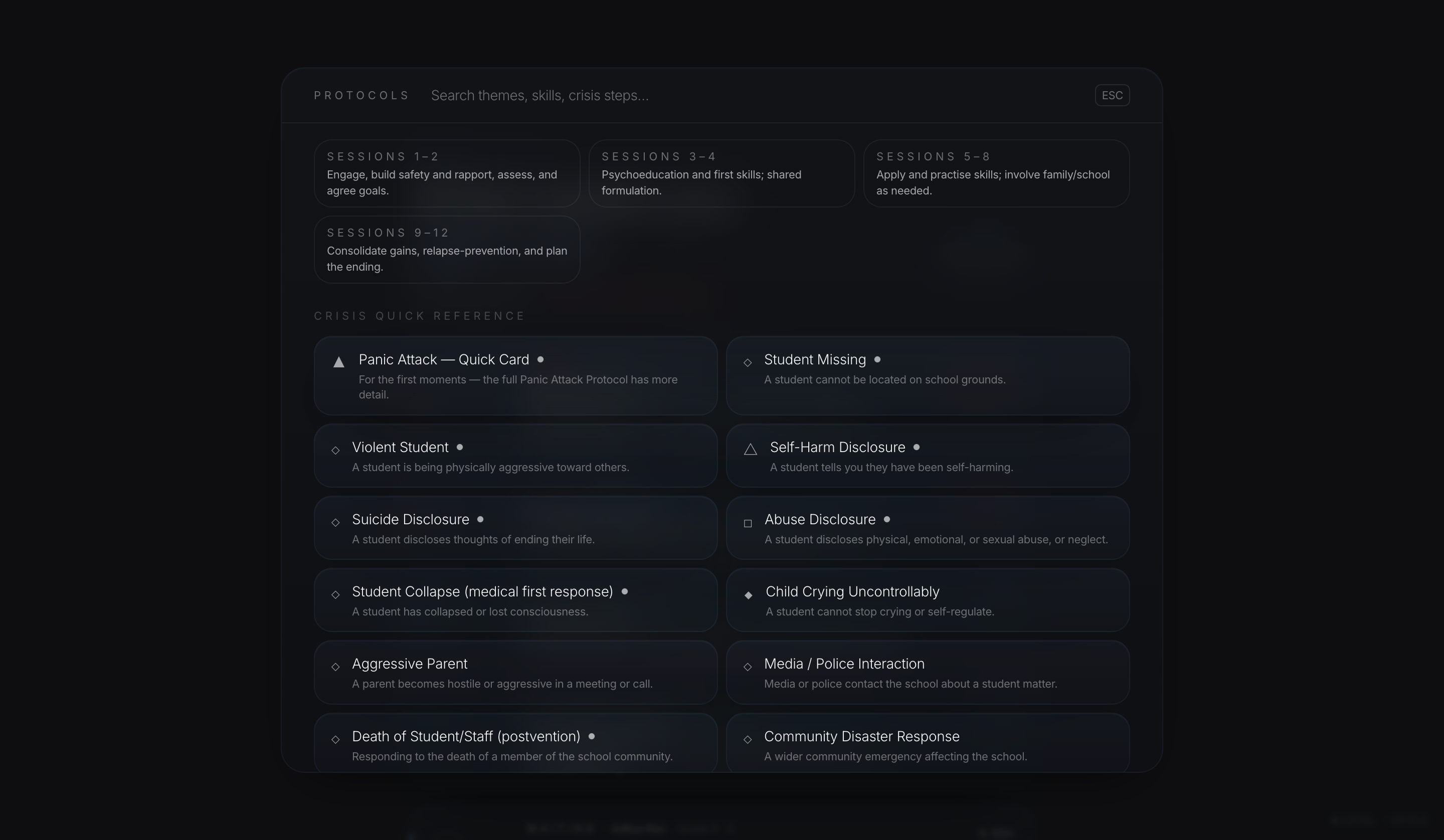
Evidence-based guidance, the moment you need it.
What used to happen: every counsellor, newly qualified or twenty years in, hits a moment mid-session where the right next step isn't obvious, and the binder two rooms away might as well not exist.
What happens now: close to eighty clinical protocol cards, organised gently by session phase and by crisis type, open right over a live session whenever you need them, so a lead counsellor's judgement and a new intern's both draw from the very same evidence.
What changes: the guidance you reach for no longer depends on who happens to be in the room that day.
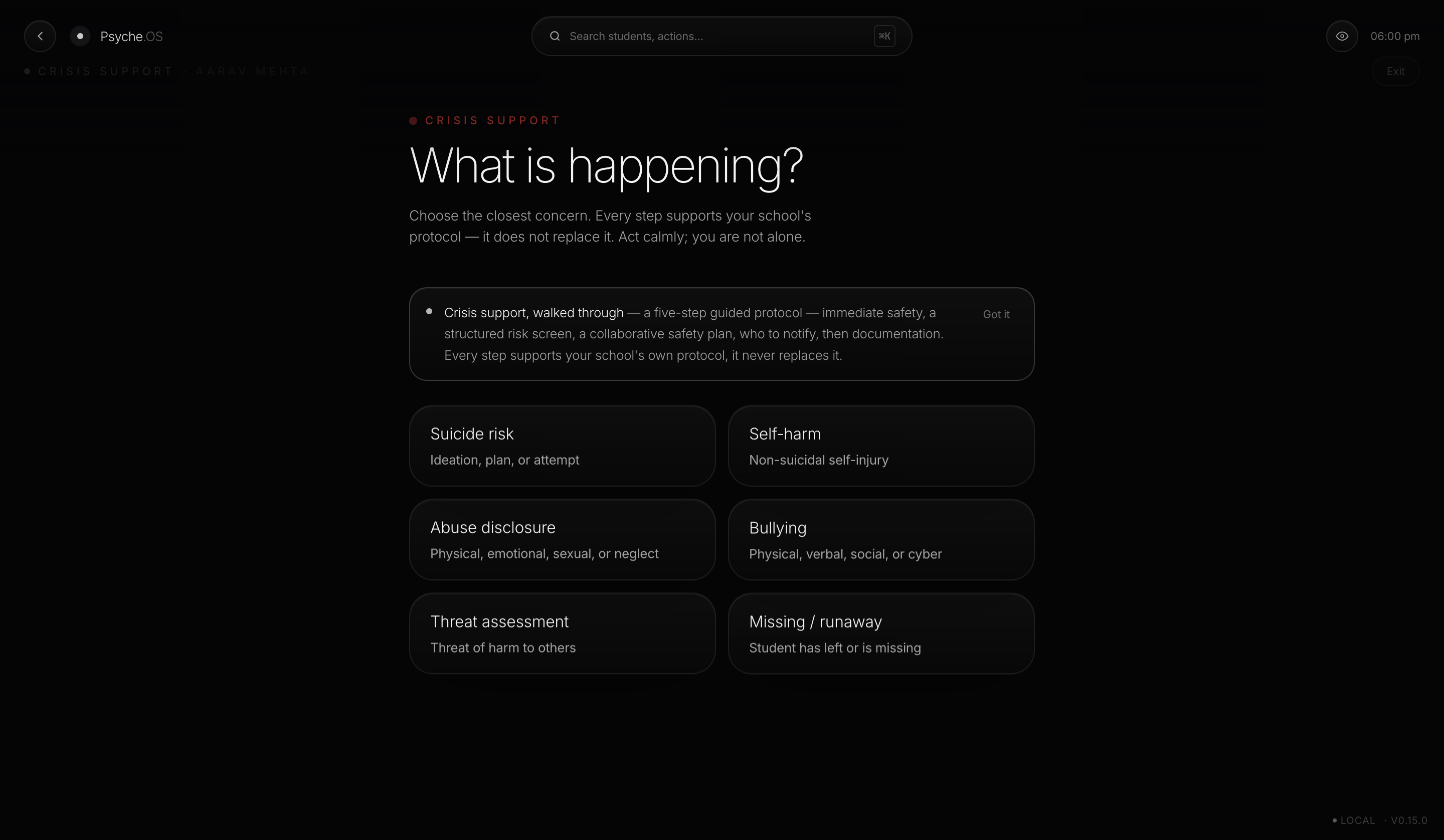
Feature 08
Crisis support, walked through, not left to memory.
What used to happen: in an actual crisis, even an experienced counsellor's protocol can blur under the weight of the moment, and a safeguarding policy filed away as a PDF was never written to be read while it's happening.
What happens now: a steady, five-step guided flow (immediate safety, a structured risk screen, a collaborative safety plan, who to notify, then documentation) built to support your school's own protocol, never to replace your judgement in the room.
What changes: nothing waits for a report to be typed up later. The record is held safely the same moment the response happens.
Feature 09
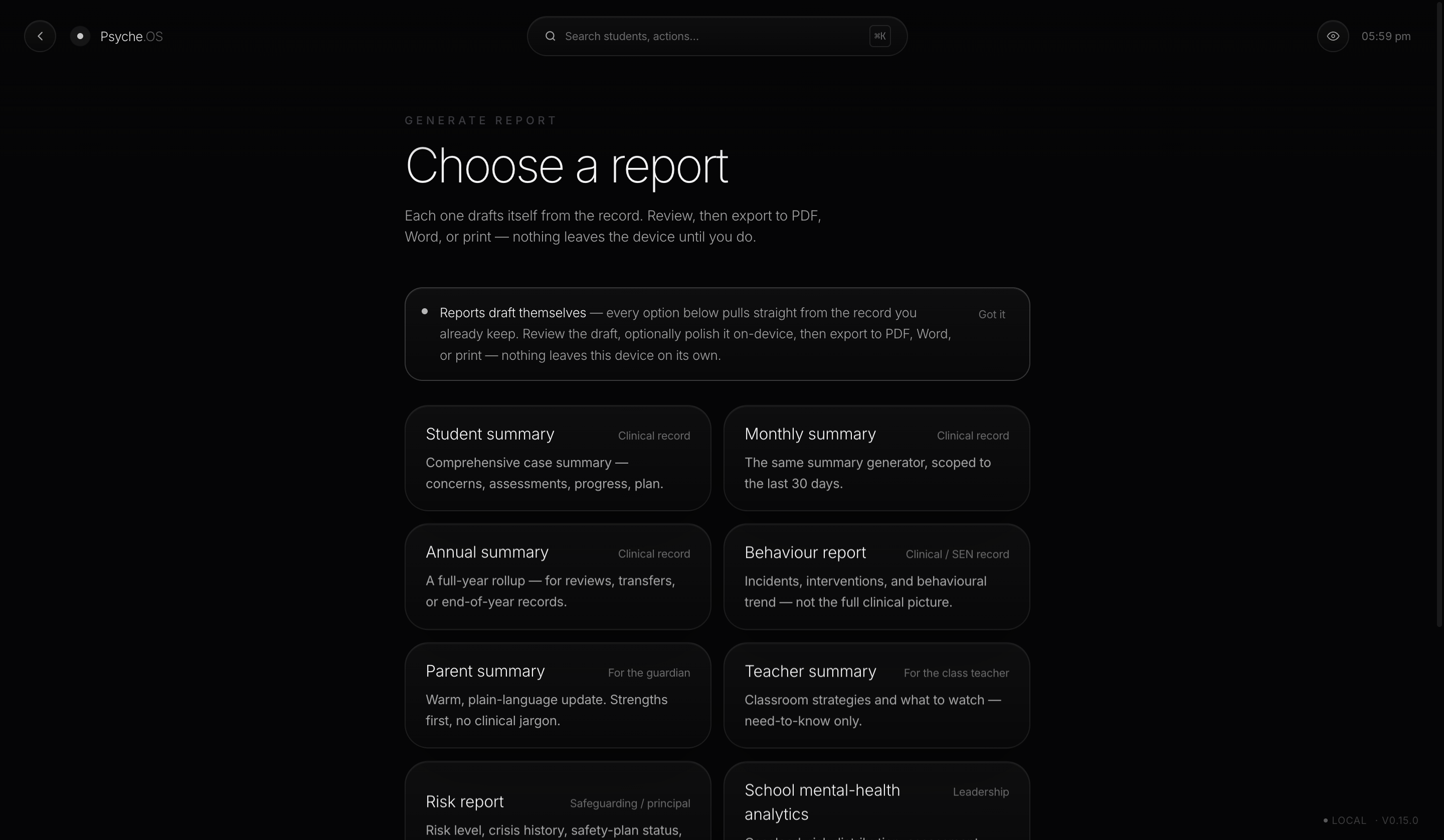
Nine reports that already know the record.
What used to happen: a parent summary, a risk report, and a teacher briefing for the very same child usually meant retelling the same story three times over, in three different tones, straining to remember it right each time.
What happens now: every report drafts itself from the record you've already kept: a warm, plain-language version for a parent, a need-to-know version for a teacher, a full clinical version for the file, then exports to PDF, Word, or print only when you say so.
What changes: three audiences who all deserve the truth, one honest source of it, nothing retyped.
More inside the console
The rest of what quietly takes care of you.
Offline AI, local Ollama
A local model runs right on the device when it can, and falls back to steady, honest drafting when it can't. Never a required call to the cloud.
Voice notes
Speak a session note instead of typing it, without ever breaking eye contact. It lands right where you'd otherwise have typed.
PIN-based multi-user login
Every counsellor unlocks with a PIN that's their own, not a shared device password. The lead counsellor genuinely holds the keys.
Reports
Nine document kinds, each generated straight from the real record you kept, never invented from scratch by a model.
Timeline search
Forgiving, typo-tolerant search across your whole caseload, by name, grade, tag, or feeling, reachable with ⌘K from anywhere.
Attachments
Files stay held with the student record they belong to, encrypted at rest, exactly where you'd look for them.
Privacy mode
One shortcut gently blurs every name and note on screen the moment someone walks past your desk.
Encryption at rest
Session notes, timeline entries, and messages are sealed with on-device WebCrypto, unreadable to anyone without your own PIN.
Local-first by design
The record lives safely on the school's own device. Nothing leaves unless you choose to send it somewhere.
User journey
A day inside Psyche.OS, scene by scene.
Not a feature list. Your arrival, a walk-in, a session, a crisis, and the quiet end of the day, each one mapped to a real screen that exists and runs today.
Documentation portal
Every document, explained the way Stripe explains an API.
What gets restored
Not more productivity. More of you, for them.
We won't call this "efficiency." That's not honest about what it actually gives back. It simply returns your time to where it always belonged: the child sitting across from you, not the paperwork about them.
The old way
1 write-up
per session, strained out of memory, hours after the room has emptied.
With Psyche.OS
0 re-typing
the note takes shape as you write it, never rebuilt from scratch afterward.
What comes back to you
Attention
right where it belongs, with the child, not the software.
Technical philosophy
Offline-first, because a child's story deserves to be kept safe, not sold.
No mandatory cloud. No account needed to open the app. Your school keeps what belongs to it, simply because that record never has to leave your own device in the first place.
Local-first storage
IndexedDB, encrypted at rest. The record lives on the device, not on someone else's server.
Encrypted vault
On-device WebCrypto seals session notes, timeline entries, and messages behind the counsellor's own PIN.
Local AI inference
Ollama, running on-device when it's available, with steady deterministic drafting when it isn't. Never a required trip to a cloud model.
No mandatory cloud
Multi-device sync is opt-in and encrypted, merged deliberately rather than silently, never a background dependency.
Data flow
in the room
WebCrypto vault
IndexedDB
encrypted export or merge
Not one step in that chain needs an internet connection, except the very last one, and that one is always a choice you make on purpose. Never a quiet upload happening behind your back.
Research
What we're still trying to learn, for your sake.
We treat every release of Psyche.OS as a question still being asked, not a finished answer. The ones we keep coming back to: how much of your "administrative burden" is genuinely necessary, and how much is just friction dressed up as process? Where does quiet, evidence-linked noticing actually help your judgement, and where would it start quietly replacing it, if we let it?
We build from watching real counselling days unfold, one session at a time, one backlog at a time, rather than guessing what "efficient" should feel like from outside the room. If we can't trace a design decision back to a real moment where a counsellor's attention was pulled away from a child who needed it, we don't ship it.
Where this goes
Something that quietly holds more, not a louder dashboard.
Every concern, goal, note, timeline entry, and referral in Psyche.OS is already gently structured and linked to real evidence. That's the groundwork for something that watches over the whole story with you, never something that shouts louder for your attention.
A gentle sense of what needs you
A quiet signal, "parent contact overdue," "this goal hasn't moved in three months, worth a look," felt through the orb, not buried in a report.
Seeing a family as a family
Context that already exists between siblings, connected on purpose, instead of pieced together by chance.
Even quieter, even gentler noticing
More care in the noticing, always by the same rule: evidence before suggestion, and never, ever a diagnosis.
This is a roadmap, not a promise with a date attached. Every item here still has to earn its place, the same way everything already shipped did.
Human Systems Lab
The real gift here was never the AI.
It's giving you back the room to think, to remember, to document gently, and to stay fully present with the children who need you the most.
A note, from me
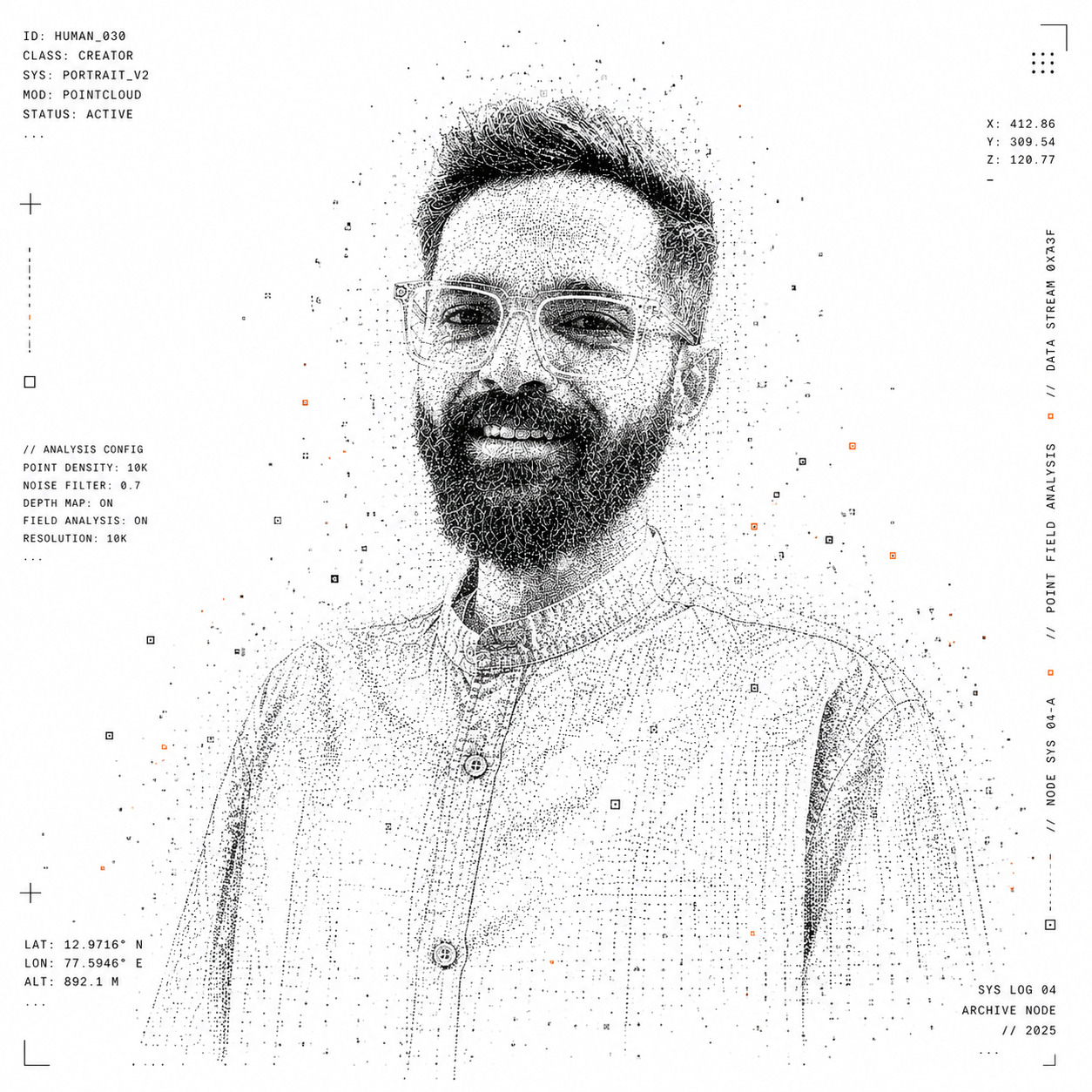
Why I built this.
There was a time the silence felt too heavy to carry alone.
I know what it's like to sit with a child's unspoken story and have nowhere safe to hold it. To end a session and still feel its weight hours later, long after the corridors have emptied. I used to wish, quietly, that someone had built something that understood both the tenderness and the exhaustion of this work, without asking anything in return.
That wish became Psyche.OS.
I built it so no other counsellor has to walk the same lonely stretch I once did, back when help was nowhere to be found. A quiet, local-first console that lives on your own device: records, sessions, assessments, a risk register, a calendar, gentle reports, and nothing else watching.
This is my thank-you to every school counsellor who shows up before the first bell and stays long after the last, who notices the child lingering in the doorway, who carries other people's stories home without ever putting them down. You give more than most people see. I built Psyche.OS so a little more of that invisible weight is held for you, and so you have one more moment to simply be present with the young people who need you.
And there's always a free door in: Psyche.OS Lite carries the same care, so no counsellor is turned away.
With care, Jithin